
HORIZON PoC Systems
Explore comprehensive HORIZON PoC Systems, featuring our powerful HORIZON Dispatch software, secure server infrastructure, and complete wide-area network integration.
What HORIZON PoC Systems are
PoC stands for Push-to-Talk over Cellular. When discussing HORIZON PoC Systems, we are looking at the invisible but incredibly powerful infrastructure that bridges the gap between traditional radio communications and modern global broadband. Instead of relying on a localized, expensive network of physical radio towers and local repeaters, this advanced system architecture leverages existing 4G/5G LTE cellular data networks and commercial Wi-Fi to route voice, data, and GPS information instantly.
At its core, HORIZON PoC Systems act as the central nervous system for your entire mobile workforce. It is a unified communication platform where dispatchers, safety supervisors, and management can monitor, manage, and communicate with unlimited team members spread across virtually any distance. The system is comprised of secure server hosting, dynamic routing software, interactive dispatch consoles, and real-time mapping integrations. Many organizations transition to HORIZON PoC Systems when their operations outgrow their legacy local networks, when they need richer data like exact location tracking, or when they require an overarching software solution that brings multiple isolated job sites into one unified command center. It is an end-to-end operational upgrade that fundamentally changes how a business manages its people and assets.
Why teams choose HORIZON PoC Systems
Command centers and fleet managers invest in tools that eliminate communication bottlenecks and provide actionable data. Upgrading your infrastructure to HORIZON PoC Systems goes far beyond merely changing how voice is transmitted; it is about taking total control of your operational workflow. Here are the most common reasons operations managers choose to implement this network architecture:
-
Limitless wide-area routing: Unlike traditional infrastructure constrained by the line-of-sight of a local repeater, a group call routed through HORIZON PoC Systems can instantly reach team members spread out across entirely different delivery routes, remote islands, or even different time zones without any signal degradation.
-
Cost-effective infinite scaling: Expanding your communication network shouldn’t require capital expenditure for new physical towers or licensing fees for new frequencies. With a cloud-based approach, scaling your network simply means provisioning new software licenses. Your infrastructure grows digitally and instantly.
-
Centralized command and control: The overarching software provides fleet managers with unprecedented visibility. By aggregating voice data, GPS coordinates, and user statuses into a single dashboard, managers know exactly what is happening in the field at any given second, enhancing both routing efficiency and worker safety.
-
Advanced talk group flexibility: HORIZON PoC Systems allow administrators to create, modify, and dissolve communication channels dynamically from a central computer. You can build temporary groups for specific daily projects or permanent channels for distinct departments, keeping secondary chatter completely isolated from priority channels.
-
Instant network redundancy: Because the system leverages multiple commercial cellular carriers and can seamlessly failover to local Wi-Fi networks, you gain an enterprise-grade level of communication redundancy. If a carrier experiences a localized outage, the system adapts, ensuring your critical voice traffic never stops flowing.
Common work scenarios for HORIZON PoC Systems
This flexible, software-driven architecture supports a vast array of complex industries, particularly those requiring tight coordination from a central hub. Here is how HORIZON PoC Systems excel in managing complex environments:
-
Logistics, fleet, and long-haul delivery: Central dispatch hubs utilize the system to monitor dozens of delivery vehicles simultaneously. When routes need to change due to traffic or weather, dispatchers use the live map to pinpoint the closest driver and instantly route them via a direct, secure voice channel.
-
Security and large-scale event management: Command posts at large festivals or sporting events use the system’s dynamic grouping to separate parking teams, gate security, and emergency medical personnel. The dispatch console allows the command team to override all channels for emergency broadcasts instantly.
-
Construction management and contracting: Corporate offices managing multiple development projects can utilize the overarching network to create specific channels for each site. A regional project manager can sit at their desk and instantly switch from monitoring a high-rise project in the city to a residential build miles away.
-
Education and healthcare campus administration: Security offices monitoring sprawling multi-building campuses rely on the software’s geofencing and GPS capabilities. If an incident occurs on the edge of campus, the dispatch center can immediately see which personnel are closest and coordinate an exact, rapid response.
-
Facilities and property management: Massive resort properties and corporate campuses utilize the system’s seamless Wi-Fi integration. This ensures that the maintenance coordination managed by the main office is never dropped, even when workers transition into basements, elevators, or heavily shielded utility rooms.
The Core of HORIZON PoC Systems:
Infrastructure and Dispatch
The true power of HORIZON PoC Systems does not lie in the devices your team holds, but in the software and server architecture that ties them all together. This robust backend ensures that every megabyte of voice data and GPS information is delivered securely and instantly.
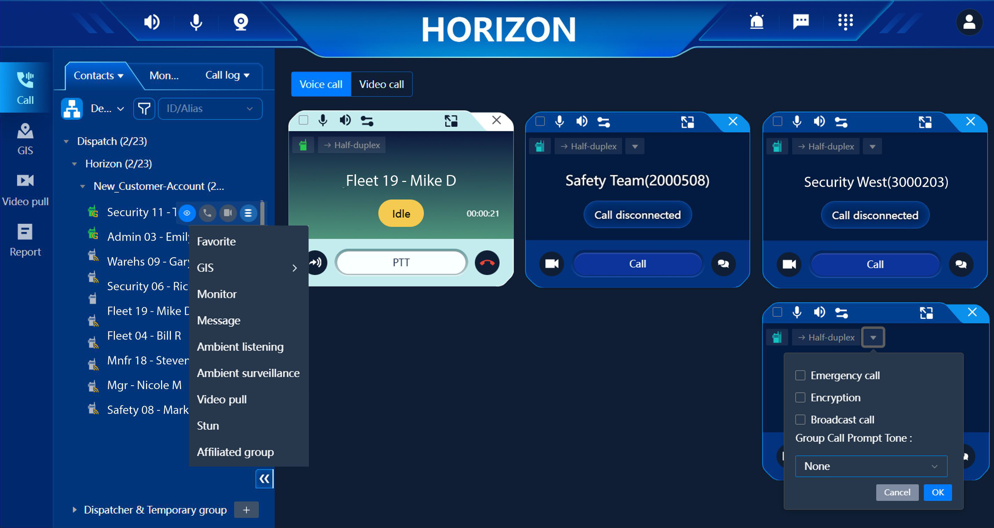
HORIZON Dispatch
HORIZON Dispatch is the nerve center of your entire communication network. It is a powerful, feature-rich, PC-based software solution designed to give your command center absolute visibility and control over the field. Integrating HORIZON Dispatch into your HORIZON PoC Systems transforms a standard PC into a high-tech communication hub.
With this software, office staff can monitor multiple talk groups simultaneously on a single screen. The interactive live map utilizes constant GPS pings to display exact user locations, speed, and movement history. Dispatchers can send instant text messages to groups, trigger emergency alarms, and utilize private, one-to-one calling for sensitive information. For any business with a mobile workforce, HORIZON Dispatch is the critical link that elevates the system from standard voice communication to a comprehensive fleet management tool.
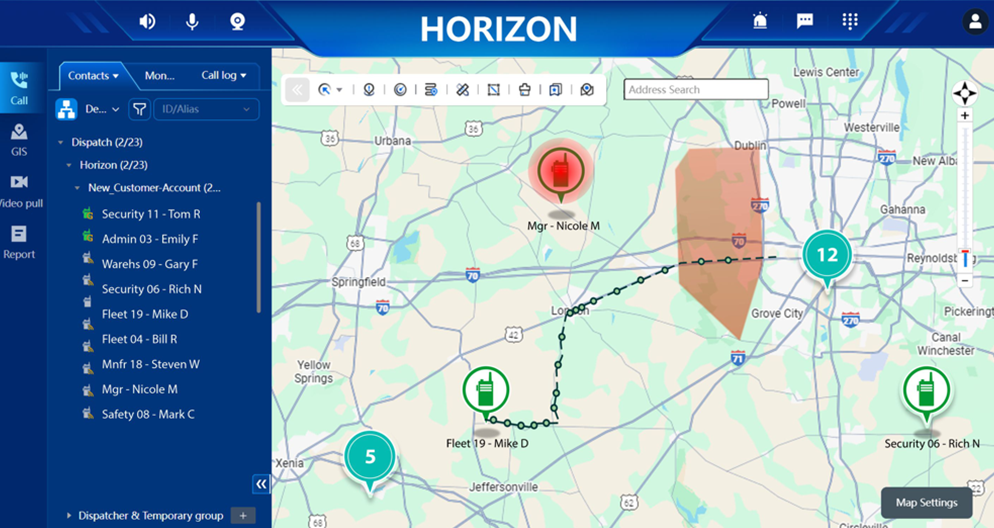
Advanced GPS Tracking and Geofencing
A major component of HORIZON PoC Systems is the integration of location-based services directly into the communication flow. The server infrastructure constantly receives and logs GPS data. Through the dispatch software, administrators can draw virtual boundaries (geofences) on the map around job sites, delivery zones, or restricted areas. If a user enters or exits these predefined zones, the system automatically triggers visual and audible alerts at the dispatch center, automating supervision and enhancing security protocols.
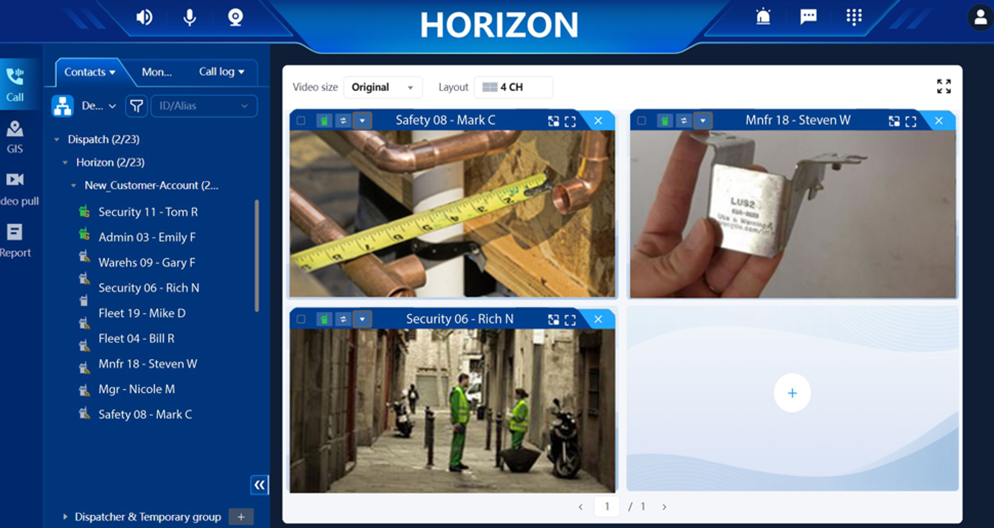
Voice Recording and Data Retention
For liability, compliance, and training purposes, memory and recall are vital. The backend of HORIZON PoC Systems can be configured to record and store all voice traffic securely. Every private call, group broadcast, and emergency alert is time-stamped, logged, and linked to the specific user ID. If an incident occurs or a customer disputes a delivery time, management can easily query the system architecture to retrieve exact audio files and GPS playback, providing undeniable operational accountability.
How to design your HORIZON PoC Systems setup
Building the right network infrastructure requires careful planning. Rather than focusing on physical hardware, successful HORIZON PoC Systems are built by analyzing data flow, command structures, and supervision requirements. Use these four quick checks to guide your system design.
#1: DISPATCH CENTER CAPABILITIES
Determine exactly what your command hub needs to see and do. Does your main office strictly need voice communication to talk to the field? Or does your dispatch team require dual-monitor setups running HORIZON Dispatch to track live vehicle mapping, manage geofences, and review historical location routes? Defining the role of the command center is the first step in system architecture.
#2: TALK GROUP ARCHITECTURE
Talk group design is arguably the most critical success factor when deploying HORIZON PoC Systems. You must architect your channels based on operational reality. Will you use a “flat” structure where everyone hears everything? Or a “hierarchical” structure where regional managers can talk to local supervisors, who then talk to their specific teams? Proper channel mapping ensures zero miscommunication and prevents network clutter.
#3: TRACKING AND GEOFENCING NEEDS
Evaluate how deeply you want to integrate location data into your daily workflow. Do you simply need to see where someone is right now, or do you need automated alerts when a driver deviates from a route? Deciding on the strictness of your geofencing rules will dictate how you configure the alert settings within the dispatch server.
#4: DATA RETENTION AND RECORDING
Consider your industry’s compliance and liability standards. Security firms and medical transport operations may require strict, long-term retention of all voice and location data. Understanding how far back you need to be able to pull historical records will help determine the server storage requirements for your deployment.
HORIZON PoC Systems Service Area and Coverage
Starcomm Wireless is proudly based in Honolulu (Kalihi) and engineers communication networks for a wide variety of commercial businesses across the Hawaiian Islands and beyond.
Because HORIZON PoC Systems operate on broadband rather than localized radio frequencies, they break through traditional geographical boundaries. The network architecture easily supports statewide reach across all of Hawaii, seamlessly connecting operations in Honolulu, the Kona Coast, and Maui. Furthermore, the system provides full nationwide reach across the continental United States by utilizing multi-carrier commercial LTE networks. You get the benefit of massive, borderless, global-scale communication infrastructure, all backed by dedicated, local engineering and customer support right here in the islands.
Frequently Asked Questions about HORIZON PoC Systems
Does this system infrastructure really work everywhere?
Because HORIZON PoC Systems are built on top of existing commercial 4G/5G cellular networks and broadband Wi-Fi, the network reaches virtually anywhere there is an internet connection. This means you have seamless coverage across cities, states, and the entire country without building a single tower.
Can field workers and the PC dispatch software communicate seamlessly?
Absolutely. This is the primary function of the architecture. A dispatcher using the PC-based HORIZON Dispatch software in the main office is fully integrated into the exact same digital network as the workforce in the field, allowing for real-time, instantaneous communication.
Is this overarching software only for massive enterprise companies?
Not at all. While large logistics companies rely heavily on HORIZON PoC Systems to manage massive fleets, the cloud-based nature of the software makes it incredibly scalable and affordable for small and mid-sized businesses. The network scales perfectly to your budget and operational size.
Do I need to buy, license, or maintain a local radio repeater?
No. The greatest financial advantage of HORIZON PoC Systems is the complete elimination of local infrastructure maintenance. There is absolutely no need to invest in, install, maintain, or FCC-license local radio repeaters. The system securely piggybacks on the billions of dollars already invested in global cellular infrastructure.
Can talk groups be managed and changed remotely?
Yes. Administrators using the dispatch console have complete control over the network. If a special event occurs, you can instantly create a new talk group, assign specific users to it, and push that update over the air to the field instantly, all without recalling any equipment to the office.
What is the best first step before deploying this network?
The best first step is to map out your current communication bottlenecks and command structure. Document who needs to talk to whom, where your current oversight lacks visibility, and what data (like GPS or voice recording) would improve your efficiency. Once you have that operational map, our engineering team will design the exact software and network configuration to solve it.